Numbers form an integral aspect of our day-to-day activities, whether handling finances, taking measurements, or tackling mathematical equations. In numerous forms of numbers available, decimals and fractions make up two of the common types. While they both serve to indicate a definite numerical quantity, they differ in the way they accomplish it. At some point in time, one needs to convert from one format to another. Such situations call for a decimal to fraction calculator to help them out.
Not only does it make the conversion easier, but it also helps save time and minimize errors. This is especially important for newbies who find it difficult converting these decimals into fractions. In this article, you will be guided on the basics of using a decimal fraction calculator and its benefits. You will also learn about how to convert decimals to fractions. Upon completion of this piece, you will have mastered everything related to the topic.
What Is a Decimal to Fraction Calculator?
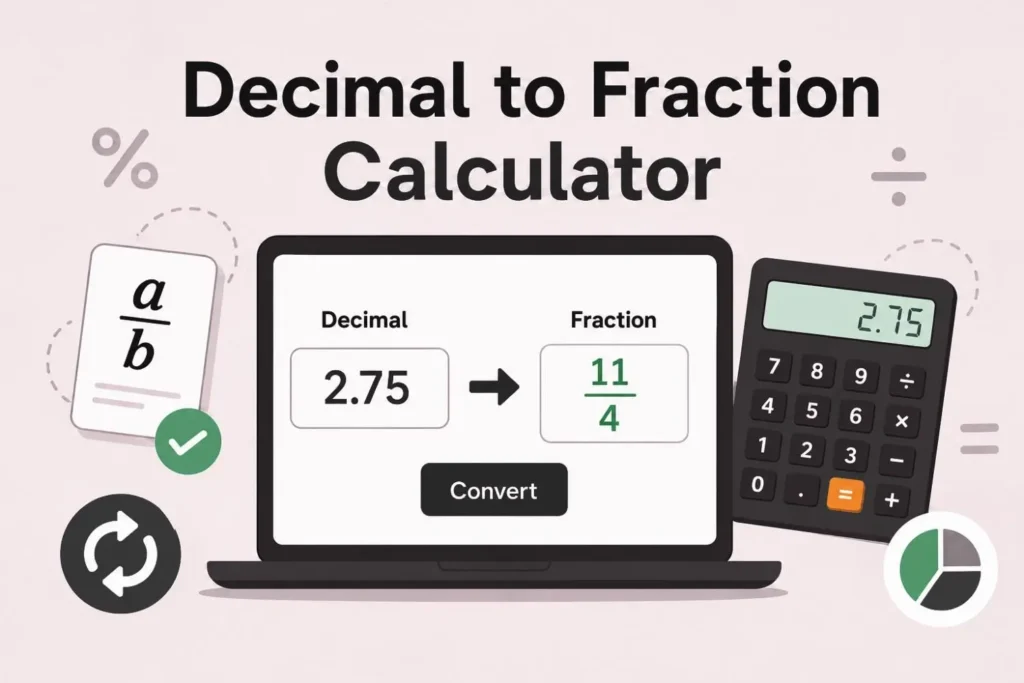
This calculator is an electronic device or application that makes it possible to convert decimal values into fractions with ease and precision. In other words, there is no need for one to perform the calculations manually because this electronic calculator will do all the calculations instantly. This particular converter is of great help to those people who are trying to understand basic math concepts. In addition to that, it also helps teachers teach about number systems with ease.
Understanding Decimals and Fractions
Before proceeding with the detailed explanation of the calculator, it is necessary to introduce some basic concepts related to decimals and fractions.
What Is a Decimal?
Decimal numbers are a form of number representation based on the decimal or base-10 numeral system, the most common numbering system in mathematics. The decimal system indicates the clear difference between whole parts of numbers and fractional parts by using a decimal separator. The numerals to the left of the decimal separator are integer numbers, whereas the digits to their right stand for tenths, hundredths, thousandths, and others. Decimal numbers are widely applied in various scientific calculations and in the monetary system.
What Is a Fraction?
A fraction is defined as the representation of a portion of something or the ratio of one quantity to another. It has two basic components, namely the numerator, the number at the top of the fraction, which tells us the number of portions taken, and the denominator, the bottom number of the fraction that shows us how the object is divided. We can find fractions in our daily lives in cases where we need to measure ingredients, divide things among people, and calculate ratios.
Why Convert Between Them?
The use of decimals in converting to fractions has numerous benefits in various real-world applications as well as academic settings. Mathematically, it makes things easier and more accurate when it comes to calculations. In the kitchen, it helps to measure ingredients more accurately, thereby making food preparation easy. In engineering applications where it involves measurements, conversions from decimal form to fractions make it more accurate in such cases. Financial analysis is another area where fractions from decimals may be helpful.
Types of Decimals You Can Convert
There are various kinds of decimals, each having its own method, though the use of a calculator makes the process easier for all kinds of decimals.
1. Terminating Decimals
Terminating decimals are those kinds of decimal numbers whose decimal places are finite in nature; that is, they are finite in nature; therefore, unlike any other type of decimal numbers, they do not continue endlessly but instead stop somewhere along the line. The good thing about these decimals is that they are very easy to change into fractions, as all we have to do is put them above the denominator 10.
2. Repeating Decimals
In a repeating decimal, one or more than one digits keep on repeating themselves indefinitely. It is possible to express such decimals as repeating decimals by placing a bar on top of the repeating section. The process used to convert a repeating decimal into a fraction is somewhat different from that used for other types of decimals.
3. Mixed Decimals
A mixed decimal number comprises a whole number along with a fractional decimal part. For changing a mixed decimal into a fraction, the whole number and the decimal fraction are combined into a single fraction, in which the whole number forms the numerator, and 10 is used for the denominator, based on the number of digits following the decimal point. With the help of an effective decimal to fraction converter, all mixed decimals can be identified and converted accurately and easily.
How it works
The process of using the decimal to fraction calculator is as follows. First, the calculator detects the decimal number entered into it and understands the number. Second, the decimal number is converted to a fraction, whereby the number becomes the numerator in a fraction. The process involves using the place value of the number for its conversion into a fraction. Third, the calculator further simplifies the fraction and presents it in its simplest form. Finally, the calculator proceeds by simplifying the fraction.
Advantages of Using
There are several advantages associated with the use of a decimal fraction calculator that make it an invaluable tool to use. First, this type of calculator saves you time since calculations would otherwise take more time if they were done manually, especially when the decimal is too long or repeating. Secondly, this calculator makes your work easier by increasing the level of accuracy since no mistakes from your side will be made while doing the calculations. Using a decimal fraction calculator is quite easy because even non-mathematical people can still easily use it. A decimal fraction calculator can be used to handle complex fractions. However, the greatest advantage associated with it is its fast performance.
Conclusion
A decimal to fraction calculator is an immensely useful device that everyone who deals with figures should have. No matter whether you are a pupil, a lecturer, or a specialist in a particular field, you can easily transform decimals into fractions using this device. Even though this device helps you save much time, knowing the algorithm of doing so manually lets you gain knowledge about the essence of the process.
Combining both ways, you can improve your skills in mathematics and be sure that you know everything about transformations. In the modern high-tech environment, such devices help people to simplify their lives and get new information. Therefore, when you face decimals once again, you know precisely what to do with them.
FAQ’s
Q1. Do decimal fraction calculators produce accurate results?
Yes, decimal to fraction calculators deliver very accurate results and a lower human error margin.
Q2. Can all decimals be expressed in terms of fractions?
Yes, decimals can all be expressed as fractions.
Q3. Do you need mathematical knowledge to operate the calculator?
No, the calculator requires no mathematical background. All you have to do is enter the decimal number and click on calculate.
Q4. Does the calculator automatically simplify the result into the lowest terms?
Yes, all good calculators will automatically give you the reduced fraction.
Q5. Can you operate the calculator via mobile?
Yes, all good calculators support mobile devices.